
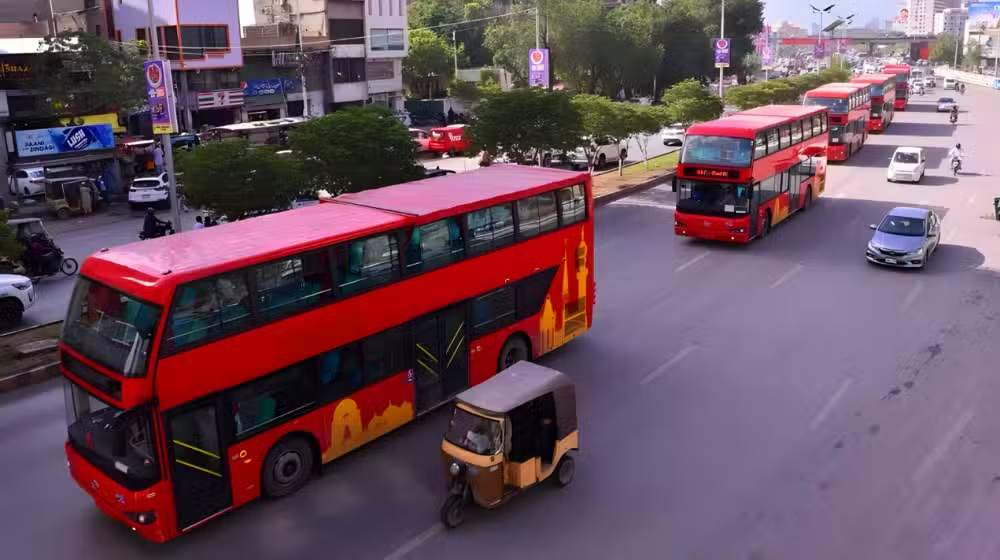
The provincial government of Sindh has announced plans to expand Karachi’s public transport network with the introduction of additional electric vehicles (EVs) and double-decker buses aimed at improving urban mobility in the city.
The announcement was made by Sindh Senior Minister for Transport Sharjeel Inam Memon during a meeting of the Transport and Mass Transit Department held in Karachi.
The meeting focused on ongoing and future public transport initiatives designed to modernize Karachi’s mobility infrastructure and provide more efficient and environmentally friendly travel options for commuters.
Senior officials, including Transport Secretary Asad Zamin and Saleemullah Odho, also attended the session where key transport expansion plans were reviewed.
According to the announcement, the government is actively working on increasing the number of electric buses in Karachi as part of its broader push toward sustainable and low-emission public transportation.
The inclusion of double-decker buses is also being planned to enhance passenger capacity on high-demand urban routes, particularly in densely populated areas of the city where commuter volumes continue to rise.
Officials said the initiative aims to reduce traffic congestion, improve commuting efficiency, and provide citizens with more reliable and modern transport services across Karachi.
The introduction of electric vehicles aligns with global trends toward cleaner energy-based transportation systems, which are increasingly being adopted by major cities to address air pollution and fuel dependency.
Karachi, being Pakistan’s largest metropolitan city, faces significant challenges related to traffic congestion and limited public transport options. The expansion of the mass transit system is expected to ease pressure on existing transport infrastructure.
The Sindh Mass Transit Authority has been working on multiple projects in recent years, including bus rapid transit (BRT) systems and fleet modernization programs, to improve urban mobility in the province.
Officials indicated that further details regarding the procurement process, deployment timeline, and routes for the new EV and double-decker buses will be shared in upcoming phases of the project.
Public transport experts have welcomed the move, noting that increased investment in electric mobility and high-capacity buses could significantly improve commuting conditions in Karachi if implemented effectively.
The initiative reflects the provincial government’s broader focus on upgrading public infrastructure and promoting environmentally sustainable transport solutions in urban centers.
As planning continues, citizens are expected to see gradual improvements in Karachi’s public transport system, particularly in terms of accessibility, efficiency, and service quality.