
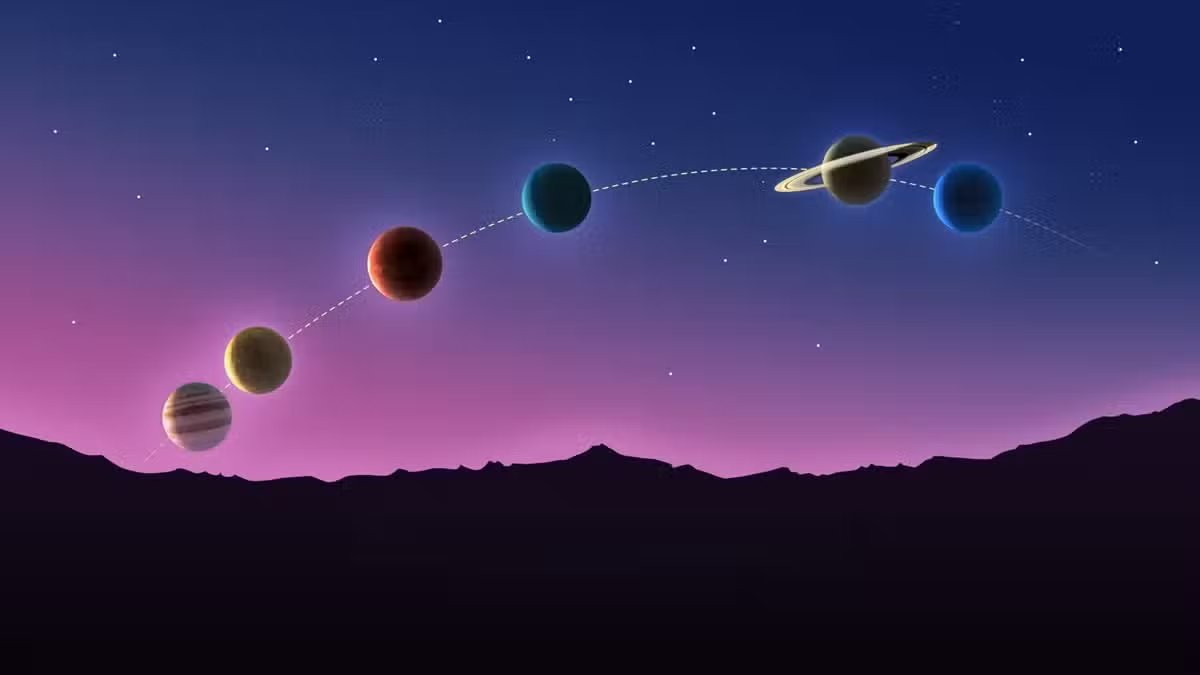
Skywatchers are in for a striking celestial event on August 12, when six planets are expected to appear together across the pre-dawn sky.
Jupiter, Mercury, Mars, Saturn, Uranus and Neptune will be positioned along the ecliptic, creating a broad planetary arrangement that stretches from the eastern horizon toward the southwestern sky.
The event is being described as a planetary alignment because several planets will appear in the same general region of the sky from Earth’s perspective. The planets are not actually lined up in a perfectly straight row in space.
The best opportunity to observe the display will be before sunrise, when the planets are positioned above the horizon. Viewing conditions will depend on the observer’s location, local weather and the brightness of the surrounding sky.
Some of the planets should be easier to identify than others. Bright planets such as Jupiter and Mars can be more noticeable to the unaided eye, while Mercury’s position close to the horizon can make it more challenging to spot.
Saturn may also be visible during the early morning hours. Uranus and Neptune, however, are much fainter and generally require optical assistance for reliable observation.
The planetary display offers an opportunity for both experienced astronomers and casual skywatchers to observe several members of the solar system during the same viewing period.
To get the best view, observers should choose a location with a clear view of the horizon and as little artificial light as possible. Urban light pollution can make faint celestial objects difficult to see, particularly the more distant planets.
Binoculars or a telescope can improve the experience for observers hoping to locate the fainter planets. However, anyone using optical equipment should take care when observing the sky around sunrise and avoid looking directly at the Sun.
Planetary alignments occur because the planets orbit the Sun on broadly similar planes. As Earth moves through its own orbit, different planets can appear grouped together from our viewpoint on Earth.
These events can create an impressive visual effect even though the planets remain separated by enormous distances in space.
The August 12 display is particularly interesting because six planets are expected to be visible across a wide section of the sky. The arrangement provides an opportunity to observe multiple worlds in a single early-morning session.
Skywatchers should check their local sunrise time and begin observing before the sky becomes too bright. A clear eastern and southwestern horizon will provide the best chance of seeing as much of the planetary arrangement as possible.
Weather conditions will also play a major role. Clouds, haze and atmospheric pollution can obscure planets close to the horizon, so observers may need to select a location with better visibility.
For astronomy enthusiasts, the event is another reminder of how dynamic the night and early-morning sky can appear. With the right conditions, August 12 could provide a memorable opportunity to look across the solar system from Earth.