
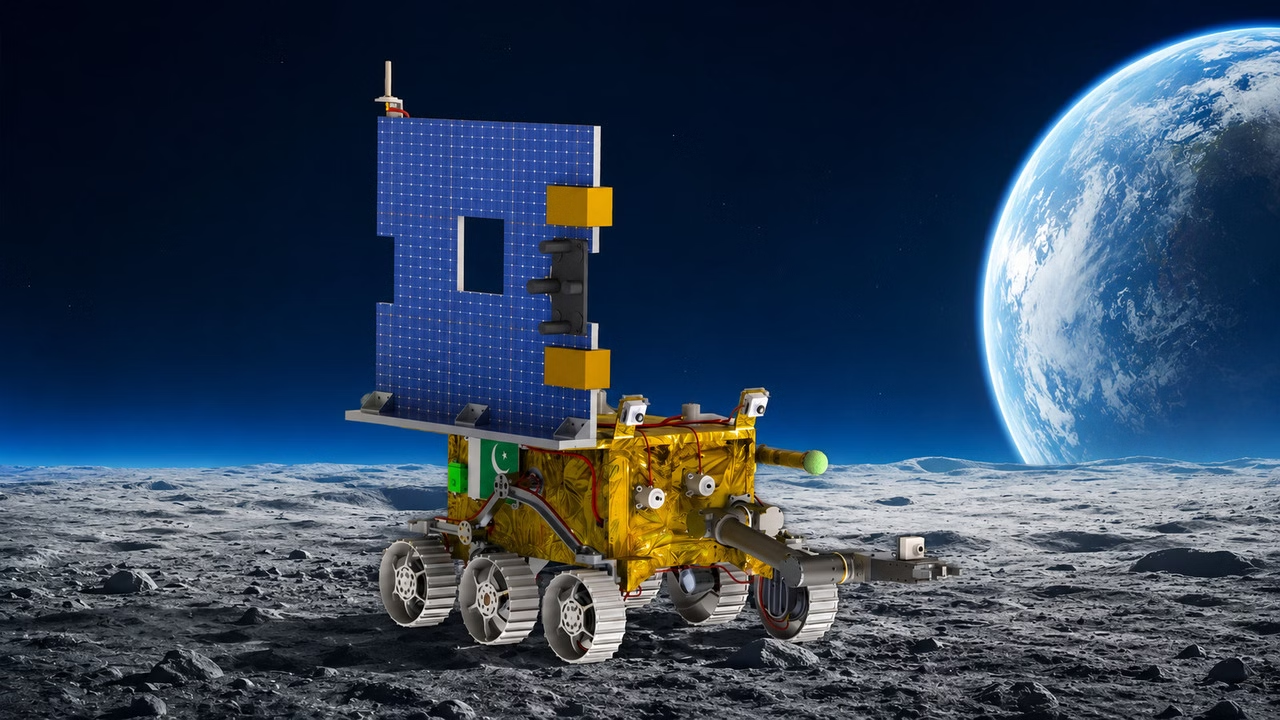
Pakistan is preparing for a major milestone in its space program, with the country’s first lunar rover, Jinnah-1, expected to reach the Moon in 2028.
The development was shared by Space and Upper Atmosphere Research Commission (SUPARCO) Chairman Yousuf Khan, who said Pakistan is continuing to expand its capabilities in space technology and satellite development.
Speaking at an event held to commemorate World Space Week, Khan highlighted the progress made by Pakistan’s space program in recent years, particularly in the development and operation of satellites.
The planned lunar mission represents another step in Pakistan’s efforts to expand its role in space exploration. If the mission proceeds according to the announced timeline, Jinnah-1 would become Pakistan’s first rover to land on the lunar surface.
The project also reflects the growing focus on developing domestic expertise in advanced space technologies. Lunar missions require capabilities in areas such as spacecraft engineering, communications, navigation, remote sensing and scientific data collection.
Pakistan has been increasing its involvement in satellite-based technology, with space assets supporting applications across communications, environmental monitoring, agriculture, disaster management and other sectors.
The development of a lunar rover could provide opportunities for Pakistani scientists and engineers to gain experience in technologies associated with deep-space and lunar exploration.
Jinnah-1 is expected to form part of the country’s broader space ambitions as Pakistan works to strengthen its scientific and technological infrastructure. A successful lunar mission would also represent a significant achievement for the country’s space research community.
The announcement comes as countries around the world continue to expand their lunar exploration programs. The Moon has become a major focus of international space activity, with missions targeting scientific research, technology demonstrations and future exploration capabilities.
For Pakistan, the planned 2028 landing would mark a transition from primarily satellite-focused activities toward a more ambitious phase of space exploration.
The timeline announced by SUPARCO will remain subject to the technical development, testing, launch arrangements and other requirements associated with a lunar mission.
Further details about Jinnah-1, including its launch vehicle, scientific objectives, landing location and onboard equipment, are expected to become clearer as the project advances.
The planned mission demonstrates Pakistan’s interest in developing space capabilities that extend beyond Earth observation and satellite operations. If successful, Jinnah-1 could become an important milestone in the country’s space exploration efforts.